00%


Mukul Kumar
Author
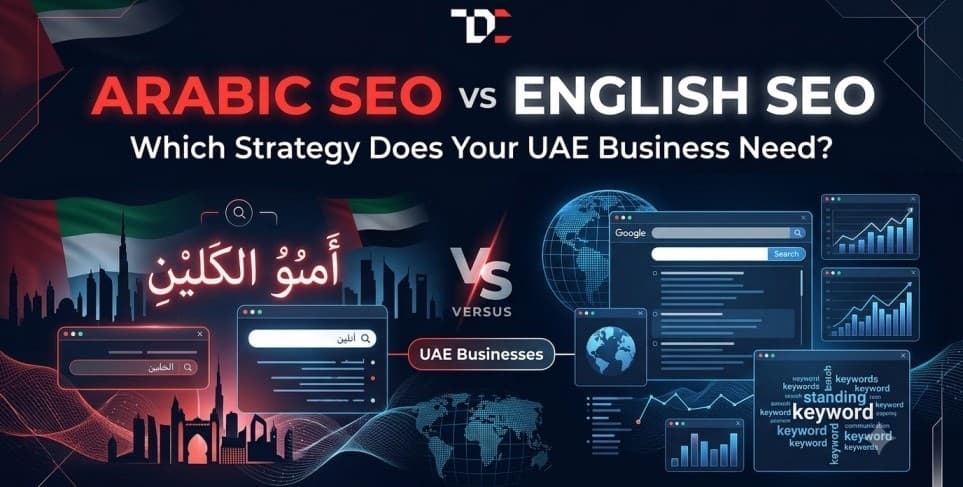
Quick Answer: Most UAE businesses need both, but rarely in equal measure. English SEO reaches the expatriate majority, while Arabic SEO reaches Emirati nationals, Arab expatriates and GCC visitors who search in their own language, often against far fewer competitors. Your sector, your customers and your current rankings decide which one comes first.
The UAE has 11.3 million internet users and an online penetration rate of 99%. Those users search in two languages, and Google treats each language as a separate results page with its own set of competitors.
That split creates the real question for a Dubai or Abu Dhabi business. You are not choosing between Arabic SEO and English SEO forever. You are choosing where to spend the next six months of budget.
This guide compares both on audience, competition, keywords and technical setup, then gives you a decision framework.
Arabic SEO is the practice of ranking Arabic-language pages in Google for queries typed in Arabic. It covers Arabic keyword research, native Arabic content, right-to-left (RTL) page design, hreflang tags and Arabic local listings.
SEO in Arabic is not translation. A translated page targets the words your English customer used. An Arabic SEO page targets the words your Arabic-speaking customer actually types, which often differ in phrasing, dialect and intent.
Factor
English SEO
Arabic SEO
Primary audience
Expatriates (about 88% of residents), tourists, B2B buyers
Emirati nationals, Arab expatriates, Saudi and GCC visitors
Competition
High for most commercial terms
Lower; Arabic makes up only 0.6% of all websites
Keyword research
Standard tools return reliable volumes
Needs dialect, spelling and Arabizi checks
Content
General copywriters can produce it
Needs native Gulf Arabic writers
Technical setup
Left-to-right, standard templates
RTL layout, Arabic fonts, lang="ar", hreflang ar-AE
Time to page 1
Competitive terms often take 6 to 12 months
Often shorter, because fewer quality pages compete
Emiratis number roughly 1.33 million of the UAE's 11.57 million residents. Add Arab expatriates from Egypt, Jordan and the Levant, plus Saudi and Kuwaiti visitors, and the Arabic audience grows well beyond that number.
Search language also shifts by sector:
Consider a paediatric clinic in Al Ain. Many Emirati parents search "دكتور أطفال في العين", not "paediatrician Al Ain". An English-only site never appears for that query.
Arabic keyword research starts from your customer, not from your English keyword list. Three issues break direct translation:
A practical Arabic keyword research process looks like this:
Most bilingual UAE sites fail on technical setup, not content. Fix these five items first:
Google AI Overviews and AI Mode pull answers from pages that state facts clearly in the searcher's language. Arabic makes up only 0.6% of all websites and 1.0% of the top one million sites, so AI systems have a thin pool of Arabic sources to cite.
An Arabic page with direct answers, short paragraphs and FAQ schema stands a stronger chance of becoming the cited source. SEO in Arabic puts your brand inside AI answers your competitors have not claimed yet.
Use this framework:
Example: a Dubai brokerage stuck on page three for "apartments for sale in Dubai Marina" faces property portals with years of authority. The Arabic version, "شقق للبيع في دبي مارينا", has far fewer optimised pages. The same budget spent on Arabic SEO produces visible rankings and enquiries sooner.
You do not need to translate 200 pages on day one. Test Arabic SEO on three high-value pages for one quarter:
Run SEO in Arabic alongside a local SEO strategy for Dubai and Abu Dhabi, so Arabic pages and Arabic map listings support each other.
The Digital Creations builds bilingual websites and runs Arabic SEO and English SEO campaigns from Abu Dhabi for businesses across the UAE. We fix your hreflang and RTL setup and write the content your Arabic-speaking customers search for. Speak with our team to get a bilingual keyword gap review for your website.
1. Do people in the UAE search Google in Arabic?
Yes. Emirati nationals, Arab expatriates and GCC visitors search in Arabic, especially for healthcare, government, education and family purchases. Many switch to English for B2B queries, so Arabic SEO works best alongside English SEO.
2. Can I just translate my English website into Arabic?
No. Translation copies English phrasing, while Arabic users search with different words, dialects and spellings. Native content built on Arabic keyword research ranks and converts better.
3. Is Arabic SEO cheaper than English SEO in the UAE?
Per keyword, it often costs less, because fewer quality pages compete. Native writing and RTL development add cost, so budget for content and technical work rather than translation fees.
4. Should I use a subdomain or a subdirectory for Arabic pages?
Use a subdirectory such as /ar/. It keeps link authority on one domain and makes hreflang setup and Search Console tracking simpler.
5. How long does Arabic SEO take to show results?
Google usually indexes new Arabic pages within a few weeks. Low-competition Arabic terms often reach page one within three to six months, while competitive terms take longer. Domain authority and the quality of your SEO in Arabic decide the pace
Ready to build something your audience remembers?
Start a Project© 2026 The Digital Creations. All rights reserved.